Pages

Sunday, September 18, 2011

Momoo's Banana Bread - Guest Post by Liz

We had three browning bananas on our counter, and although this is the color I prefer my banana to be, I decided to use them to make banana bread for Drew and I to have for the week.


I like to use my grandmother’s recipe, whom my brother and I affectionately referred to as Momoo (pronounced MOM MOO), while the other cousins called her Grandma and didn’t like that the youngest cousins had made up this strange name that seemed to take precedence.

The last few times I made Momoo’s banana bread recipe I decided to alter it slightly. Drew came across a recipe that required whole wheat flour and so we had some of it sitting in our kitchen cabinets and the Fraker in me doesn’t like to waste, so I decided to halve the flour in the banana bread recipe with ¾ whole wheat flour and ¾ regular flour. Drew and I both couldn’t tell the difference and decided to use this combination going forward hoping there were some nutritious benefits. 


One other way to make it a bit healthier was to use ¾ cup of sugar instead of 1 cup. Again, we couldn’t tell a difference between leaving out a little sugar, so we continue to do that. Also, we learned from a cooking show that if you heat up the mashed up ripe bananas in microwave it releases more of their sugars and will naturally make the bread sweeter. You can also add 4 bananas instead of 3, which we have also tried.

Below is Momoo’s recipe, which as her recipes often were, is straight and to the point without a lot of guidance or description:


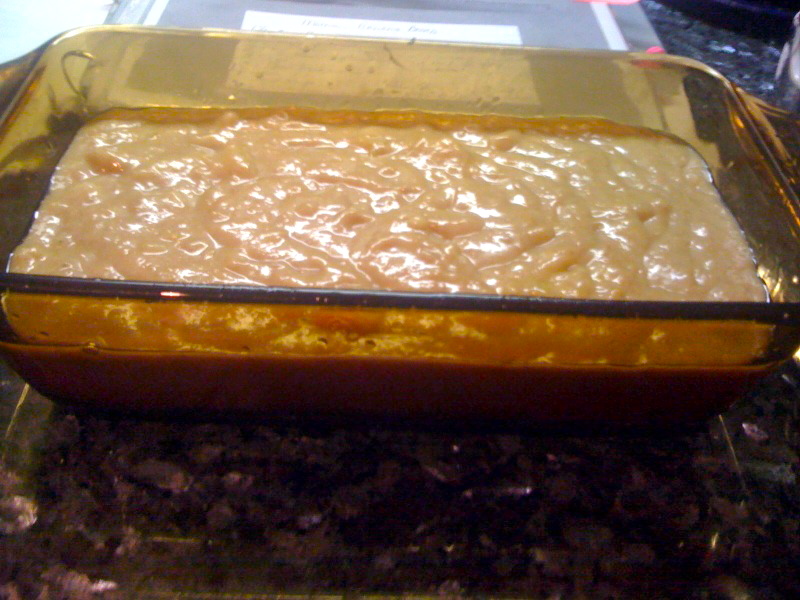
For some reason when I decide to make banana bread I have a lot on my mind or I loose focus. Which could be in part because I have made it many times before so I don’t think I need to concentrate as much. But almost every time I make it I don’t mix the ingredients in the right “order”. So this time I put in all of the dry ingredients together (including sugar) and then realized I should have started with mixing the softened butter (which I think is better off just completely melted for mixing purposes), eggs, bananas and sugar. I was able to salvage this a bit and scoop up the sugar from the top of the dry ingredients and add it over to the eggs, butter and banana mixture. So pictured below is the ingredients all mixed together before adding to the pan. I have messed it up almost every time, and it hasn’t made a taste difference yet!


After you have poured the mixture in a greased 5 by 9 bread pan you bake it for about 50 minutes uncovered.


And then you have delicious warm banana bread, which I forgot to take a picture of before I took my first piece! Enjoy!


Saturday, September 17, 2011

Dinner by Dylan

Last Friday Liz and Drew flew into Chicago for a wedding, and headed to Drew's brother's and brother's girlfriend's apartment to drop their stuff before going out for drinks.  So after a long day work and traveling, it was a nice surprise to find that Dylan had made some dishes!


We started with a bottle of Cycles Gladiators cabernet sauvignon wine and a charcuterie plate, filled with pepper-crusted salami, green grapes, a variety of crackers, and a really creamy brie infused with blue cheese.  The cheese was outstanding-great brie taste tempered with just a hint of medium pungent blue cheese.


For Act II, Dylan created a couple of flat bread pizzas using plain naan, an Indian flat bread, as a base.  One pizza was a bruchetta pizza, complete with torn fresh basil, & diced tomato, fresh mozzarella.  The other pizza was topped with BBQ chicken and fresh mozzarella.
The pizzas were hot and crusty & the flavors of the toppings melded together nicely.  In short, a very thoughtful & tasty way to start our trip to Chicago!

Friday, September 9, 2011

Paging Doctor Corn Cob....


Drew read today in the Wall Street Journal that a hospital in Iowa recognized a disconnect between the patients they were serving and the predominantly foreign-born medical staff they employed; in short, the doctors at the hospital were having trouble connecting with the patients at the "bedside manner" level, resulting in a sub-par medical experience on both ends.  The hospital is working to solve this by mandating classes taught by two University of Northern Iowa sociologists who educate the doctors on topics covering the University of Iowa Hawkeyes sports teams, Midwestern dialect, and the importance of corn; homework assignments include directives to attend State and county fairs.  Drew often (half) jokes that he would love to go back to the University of Chief Illiniwek for a PhD in sociology, so Carle Hospital, if you're reading, can we strike a deal?!?! 


So all that talk of Iowa corn is a nice segway into a Thomas Keller recipe we made last weekend while Liz and Drew were home in Champaign:  Creamed Summer Corn.

Liz and Drew started the recipe off right by shucking a dozen ears of fresh "Peaches & Cream" sweet corn straight from the Urbana Farmer's Market.


After the corn was shucked, it got a quick rinse in the sink where Drew took a vegetable brush to it to remove every last silk, a practice that garnered Drew some laughs and weird looks from the Merees.

So in all honesty, the recipe unintentionally got a "Ad Hoc" spin very quickly when Drew began to boil the ears of corn in batches.  According to the real recipe, the corn is not to be pre-boiled, but again, Drew's love of a new spin (read: lack of reading thoroughly) resulted in a new twist.


After cooking the corn in two batches, we let it cool, and Drew began slicing the corn off of the cob.  The real TK recipe starts here & calls for the chef to not only preserve the corn kernels, but also the corn "milk," the white liquid that drains out of the cob.  A quick trick to "milk the cob" is to flip the blade of your knife and run the dull side of the blade along the stripped cob over a bowl.


When all the corn cobs are sliced, melt 3 tablespoons of butter over medium heat before adding the corn, the juice of two limes, and salt & pepper to test.  The real recipe calls to cook the corn over medium-low heat for approx. 15 minutes or until all the liquid has evaporated and the corn is beginning to sizzle.  We cooked our about 5-7 minutes since we had pre-cooked the corn.  After the liquid soaked up into the corn, we added in 3/4 of a cup of heavy whipping cream, salt & pepper to taste, and chili powder to taste to balance the sweetness of the corn. 

Admittedly, this was not the best recipe to put an "Ad Hoc" spin, but the end result was good and well liked by the crowd we had for dinner.  But as I imagine they're teaching the doctors in Iowa, you can't go wrong with good, fresh corn!


Thursday, September 8, 2011

De-Constructed Eggplant Parm

Let it be known that Drew Keiser has absolutely no future in the construction business, so if I ever come over and offer to pour you a new drive-way or hang new windows, cart me off to the looney bin right away.  My construction experience is limited, but what I do have a passion for is deconstructing traditional dishes and giving them a new, ad-hoc if you will, spin.


While we were home in Champaign, Liz & I took a trip to the Urbana Farmer's Market (Pictured Above) to get some walking in, pick up a watermelon & sweet corn, and see the Urbana Farmer's Market Music Man (Pictured Above) who proves time & time again that sweet, sweet music can be made with a plastic kid's rake and some old tin cans.  While we were buying our sweet corn, the stall we were at was also selling eggplants, so we picked one up with no idea what to do with it, until I recalled an article I had read in the New York Times about deconstructed Eggplant Parmesan.  Since I couldn't find the article, I decided to wing it and make up a recipe on my own.

Recognizing that eggplant can be very bitter, I washed the eggplant and sliced into medium-thick rounds, placed them in a strainer in the sink, and doused them with a liberal helping of kosher salt before letting them sit for 20 minutes.  This process leaches out not only water inside the vegetable, but also the bitterness.


As the eggplant sat in the strainer, I cut a couple of tomatoes into slices before quartering the slices into half moons, and did the same with some leftover buffalo mozerella that we had used to make our caprice salad.


We had the grill at the Sterling going for flank steak and t-bones, so when the meat came off to rest, the eggplant went on for a quick grill.


After the eggplant came off the grill, we plated them on a platter, topped them with tomatoes and mozerella, and finished them a piece of fresh basil, salt & pepper, and a little extra virgin olive oil.  In thinking through the dish post-consumption, I think a the final product could be served hot & melted via a quick trip under the broiler.
.

Wednesday, September 7, 2011

Tasting Table & Thomas Keller

Like most red blooded Americans with an Internet connection, we find ourselves receiving frequent emails from businesses and organizations that we have no clue how we got signed up for, but 1 of the 4,862 we get  is worth sharing.....

Tasting Table "is a free daily email that delivers the best of food and drink culture to adventurous eaters everywhere. Each weekday, we send our members one delicious idea about dining, wine, cocktails, cooking or restaurant personalities. We feed you only first-hand recommendations that we have tested thoroughly ourselves—one bite at a time."  If memory serves me right, Tasting Table is owned by the haute kitchen retailer Williams-Sonoma.

While it seems that lately the daily email is tied to a particular product along with instructions on how to buy said product, the information provided is informative and fun to read.  Recently Tasting Table featured Champaign, IL's very own Prairie Fruit & Cheese Farm's goat cheese, a perennial favorite at the Urbana Farmer's Market and among Chicago-area chefs (Article Here).

So on a Wednesday afternoon after a holiday weekend, who should appear on Tasting Table?  None other than Thomas Keller! 


Tasting Table reports that Thomas Keller, along with his research chef (how do I get that job?!?!) Lena Kwak, have created a proprietary, gluten-free flour blend.  Named C4C-Cup 4 Cup, TK states that the potato starch-potato flour-tapioca flour-rice flour blend can be swapped in a recipe "cup for cup" with regular all-purpose flour. 

Cup4Cup Gluten-Free Flour

We're rather intrigued by this product given the attention that the media as well as some of our friends have given to the advent of gluten-free diets.  We've even heard tales of gluten-free diets improving children's ADHD and the behavioral problems.  From a baking perspective, Liz has been substituting half of the all-purpose flour content of her banana bread with whole wheat flour with great results, so we're clearly sold on the ability to substitute flours.  The C4C website had some interesting recipes to use the flour in, including a Bacon-Comte Cheese Biscuit. 

If you're feeling adventurous, the flour is available on the Williams-Sonoma website (surprise, surprise) priced at $19.95/3 lb. bag along with 3 glowing reviews of the product.

Saturday, September 3, 2011

The Pork of the Fruit World

So we thought we'd take a moment and share a book on a food topic and showcase some related dishes.

Drew recently finished reading Tomatoland: How Modern Industrial Agriculture Destroyed Our Most Alluring Fruit , which hit the Top 100 Kindle book list on Amazon.

Per Amazon :  Supermarket produce sections bulging with a year-round supply of perfectly round, bright red-orange tomatoes have become all but a national birthright. But in Tomatoland, which is based on his James Beard Award-winning article, The Price of Tomatoes, investigative food journalist Barry Estabrook reveals the huge human and environmental cost of the $5 billion fresh tomato industry.


The book proved to be an interesting expose into why tomatoes from the grocery store have no taste, can survive a fall from the tomato stand unbruised, and what drives the variation in price.  If you're stomach  is weak, this book is not for you.  Estabrook dives into the deadly chemicals used to treat tomato plants, their affects on pregnant field workers, and the real slavery that exists in the Southern tomato economy.

 Sounds pretty nasty, and a recent trip to any grocery store will confirm my point.  But I'll tell ya what's really good....

These Babies!
These puppies are from the garden of Ron & Mary Starwalt, Elizabeth's uncle & aunt.  Full of oxygen and flavor, the tomatoes' smell and taste were the epitome of what a tomato should be.  So how to pay does one pay tribute to such a quality product?  

Rule #1: You let it shine as the star of the dish, letting it's true flavors shine.

Rule #1 in Action:  Tomato Caprese Salad

We started our dish with Liz slicing tomatoes and Drew slicing balls of fresh mozzarella.  

After our chopping was complete, we arranged the tomatoes on a plate, interspersing them with a piece of cheese.  The slices got a dusting of cracked pepper and a topping of torn basil leaves, fresh from the Fraker garden.  

We finished the dish with a drizzle of olive oil and some fig balsamic vinegar from Old Town Oil in Chicago.  The end result was a refreshing and tasty summer appetizer.


Rule #2:  Only combine with ingredients of the same high quality.

Rule #2 in Action:  Homemade Garden Salsa

So while I slept in Saturday morning, Liz, French, & Judith were hard at work in kitchen making salsa.  A Midwest touch is very much alive in this salsa in that there is no fiery heat nor artificial preservatives, just flavors of vegetables fresh picked from the garden stewing in extra virgin olive oil & red wine vinegar.

The salsa recipe is from a book entitled Too Many Tomatoes, copy right 1976.  Take a close look at the picture below-notice any additions/subtractions to the recipe?  This is the Midwest cook in action!
Nix the Heat; Add in Freshness!

French kicked things off by using a tomato peeler to remove the skins of 4 medium tomatoes before they got a quick dice.


While French was dicing tomatoes, Liz diced a 1/2 an onion & a whole green pepper straight from the garden and Judith minced 1/2 cup of Schnuck's finest celery. 

In a large mixing bowl, 1 teaspoon of salt, 1 tablespoon of sugar, 3 tablespoons of olive oil, and 2 tablespoons of red wine vinegar were combined before the diced vegetables were added to the mix along with 8 leaves of chopped basil.  


All the ingredients were then stirred well, covered, and put in the refrigerator to chill out.  The end product was a nice meld of flavors from the acid of the tomato and the red wine vinegar & bite from the onion and green pepper.

Rule #3: Bacon makes anything and everything taste better.

So again, like the cinnamon rolls from Ann Sather's, I don't have a picture of the tasty, tasty BLTs we had for lunch today, but talk about the portrait of a local lunch-fresh bread from Mirabelle's bakery in Urbana, tomatoes and lettuce from the garden, and bacon from the University of Illinois Meat Sales Room.  Life doesn't get any better than that!

De-Constructed Local BLT-Minus the Bacon
Word to the uninitiated, you haven't lived until you've consumed a fresh, garden tomato at the peak of the season!  Have a great holiday weekend everyone!

P.S.-The Pork of the Fruit World?  Really Drew?  Translation:  Pork is the supreme meat; tomato is the supreme fruit (or vegetable, depending on which side of the argument you fall).


Swede & The City


Elizabeth & Drew made a pact after the 4th of July that they would not spend a holiday alone in Houston, so keeping true to the pact, we headed home to Chicago for Labor Day weekend!  While Liz headed south Thursday night, Drew spent the night in Chicago watching Da Bears with friends (Bear Down!) and a night out with the brother-in-law.

So with a free Friday morning, I paid homage to my heritage and had breakfast at one of the best breakfast places in Chicago (which coincidently happens to be a Swedish joint)-Ann Sather!


Known for their cinnamon roles (so good that they vanished before I could get a picture), I had the standard two eggs/potatoes/sausage/toast/coffee combo available at any diner in 'Merica, but being Swedish, that toast was a Swedish version of rye called Limpa and the sausage a Swedish potato sausage, made of pork and mashed potatoes.


While not vibrant in color nor plated with extra-care, I can't think of a better, tastier way to start off a weekend Home.  SKOL everyone!